


Congratulations — you’ve made the switch. Whether you picked up a Tesla, a Rivian, a Chevy Equinox EV, or any of the dozens of other electric vehicles now available, you’ve joined a fast-growing group of Orange County drivers who are done with gas stations. That part feels great.
Then you get home and realize: you need to figure out how to charge this thing.
EV charger installation in Orange County is one of the most common calls we get at JEC Electric from first-time EV owners who assumed the process would be more straightforward than it is — or who tried to make do with the included Level 1 cord and quickly discovered it wasn’t going to cut it for their daily driving. This guide walks you through everything you actually need to know, without the technical overwhelm.
Skip the research rabbit hole. Request a home charging consultation today and JEC Electric will assess your home and recommend exactly what you need — fast, honest, and no obligation.
Why the Included Charging Cord Probably Isn’t Enough
Every electric vehicle comes with a Level 1 charging cable that plugs into a standard 120-volt household outlet. It works. But “works” is doing a lot of heavy lifting in that sentence.
Level 1 charging adds roughly 3 to 5 miles of range per hour. If you drive 40 miles round trip on your daily commute, you need 8 to 13 hours of charging time just to replace what you used that day — before accounting for weekends, errands, or anything that pushes your mileage higher.
For some drivers with short commutes and flexible schedules, Level 1 is genuinely fine. For most Orange County drivers — where distances are real and schedules are packed — it creates a chronic low-battery anxiety that defeats a big part of the point of EV ownership.
A Level 2 home charger changes that completely. It delivers 20 to 30 miles of range per hour, meaning most vehicles reach a full charge in four to eight hours. You plug in when you get home. You wake up full. Every day.
The Three Questions That Determine Your Installation Path
Before JEC Electric recommends a specific setup for your home, we need to understand three things. You can think about these before we ever show up:
- Where will you charge? Most homeowners charge in their garage. But covered carports, driveways with outdoor outlet access, and even dedicated parking pads can all work. The distance between your parking spot and your electrical panel affects how the circuit needs to be run and factors into the overall cost.
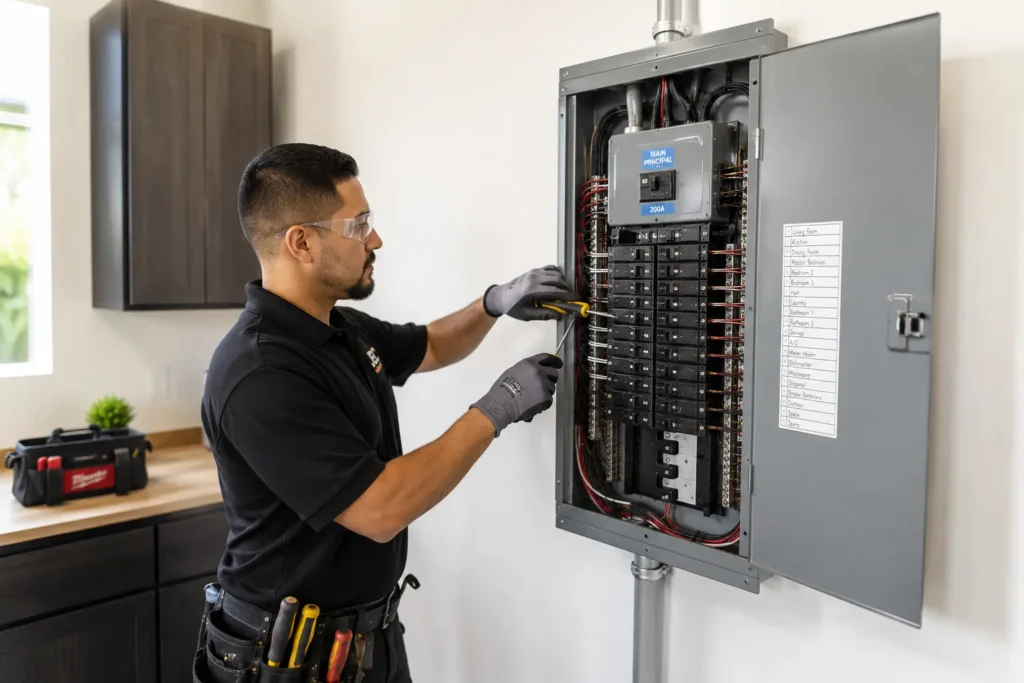
- What does your electrical panel look like? A Level 2 charger requires a dedicated 240-volt, 40- to 50-amp circuit. Whether your panel can accommodate this without any additional work depends on its current capacity and how many open slots it has. Some homes in Orange County — particularly those with older 100-amp service — need a panel upgrade first. Others have plenty of capacity and are ready to go as-is. A proper assessment tells you which situation you’re in.
- How much flexibility do you want in the future? If you’re likely to get a second EV, upgrade to a higher-capacity vehicle, or add solar down the road, it makes sense to plan for that now. Running a slightly larger conduit or installing a subpanel in the garage while the work is already underway is significantly cheaper than coming back to it later.
Choosing the Right EV Charger for Your Orange County Home
The EVSE unit — the actual charger that mounts to your wall — is separate from the circuit work. There are dozens of options on the market, and the right one depends on your vehicle, your usage patterns, and how much smart functionality you want.
Here’s a practical breakdown:
Basic hardwired units are reliable, durable, and do exactly what they need to do. They’re the right choice for homeowners who want simplicity and don’t need app connectivity or scheduling features.
Smart chargers connect to your home Wi-Fi and let you schedule charging during off-peak utility hours. In many Orange County utility zones, electricity is meaningfully cheaper during overnight hours. A smart charger can automatically take advantage of this, reducing your monthly charging cost without you having to think about it.
Higher-amperage units (48-amp vs. 32-amp) charge faster but require a larger circuit. For most current EVs, a 32-amp charger is plenty. If you drive a vehicle with a large battery or have two EVs in the household, a 48-amp unit may be worth the modest additional cost.
JEC Electric works with all major EVSE brands and can help you choose the unit that fits your situation — not just the one with the highest margin.
What the Permit Process Looks Like (And Why It Matters)
EV charger installation in Orange County requires a permit in most jurisdictions, and this is not a step to skip. Here’s why it matters beyond simple compliance:
A permitted installation is inspected by the local Authority Having Jurisdiction, which means a third party has verified the work was done correctly. This matters for your homeowner’s insurance — some policies have provisions around unpermitted electrical work. It also matters when you sell your home, since unpermitted work can complicate or delay a transaction.
JEC Electric handles the entire permit process. We submit the application, schedule the inspection, and make sure everything passes before we close the job. You don’t have to navigate any of that paperwork yourself.
Frequently Asked Questions: EV Charger Installation in Orange County
Q: How soon after buying an EV should I get a home charger installed? As soon as possible, honestly. Living on Level 1 charging while you wait creates unnecessary stress. Most installations in Orange County can be scheduled within one to two weeks of your initial consultation.
Q: Can I install a Level 2 charger in an apartment or condo in Orange County? This depends on your building and HOA. Some Orange County condo buildings have installed shared EV charging infrastructure, and California law (AB 2565) provides some protections for EV owners in HOA communities. For renters or condo owners, we recommend checking with your HOA or property manager first.
Q: Does JEC Electric install Tesla Wall Connectors? Yes. We install Tesla Wall Connectors, ChargePoint Home Flex, JuiceBox, Enel X JuiceBox, and other major EVSE units. We can also help you determine whether a universal J1772 charger or a Tesla-specific unit makes more sense for your situation.
Q: Will EV charging significantly increase my electricity bill? It adds to your bill, but typically much less than the equivalent fuel costs. The average Orange County driver spending $150–$200/month on gas typically sees $40–$60/month added to their electricity bill when charging at home — a significant net saving. Smart charger scheduling during off-peak hours reduces this further.
Make Home Charging as Simple as It Should Be
Getting your first EV is exciting. The home charging setup shouldn’t be the part that causes headaches. JEC Electric handles EV charger installation in Orange County from start to finish — assessment, permits, circuit work, charger installation, and final inspection — so you can focus on enjoying the drive.
Request your home charging consultation today — it’s completely confidential, takes just a few minutes to set up, and gives you a clear picture of exactly what your home needs and what it will cost. No surprises, no pressure. Just a cleaner commute starting soon.
